
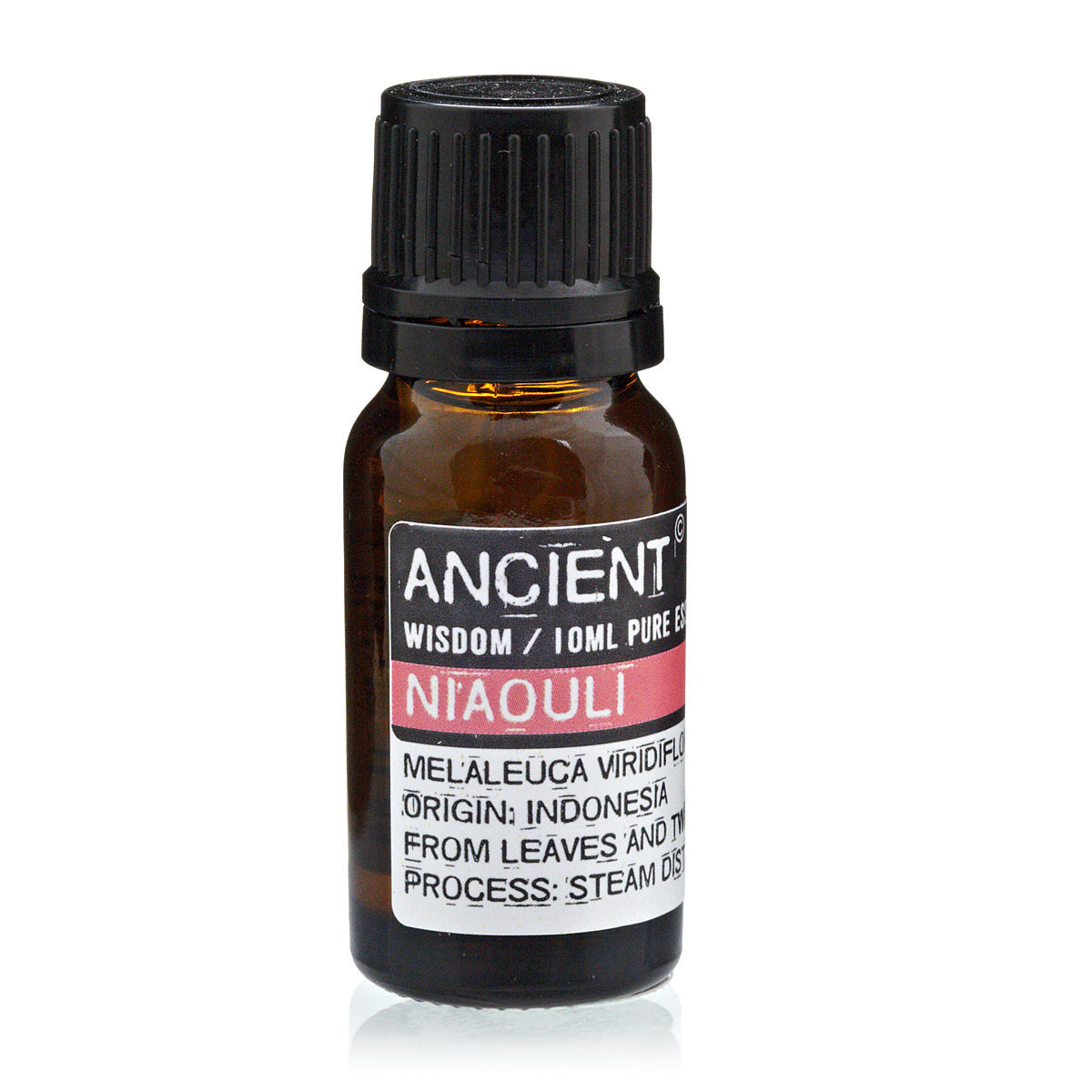
Niaouli Essential Oil offers a fresh, camphoraceous aroma with a clean, airy lift. This guide covers its key notes, easy diffuser blends, ambient uses, and practical safety tips so you can enjoy it confidently at home.
Quick facts
- Latin name: Melaleuca quinquenervia (ct. cineole commonly used)
- Plant part: Leaves and twigs
- Extraction: Steam distillation
- Character: Fresh, airy, camphoraceous, clarifying
Aroma profile
Niaouli leans bright and clearing, with a gently resinous backbone. It brings a crisp, tidy quality to blends and pairs well with citrus and woods for balanced, everyday diffusion.
- Overall: Fresh, clean, camphoraceous
- Pairs with (bright): Lemon, Grapefruit
- Pairs with (herbal): Rosemary, Lavender
- Pairs with (grounding): Cedarwood, Frankincense
How to use (ambience)
Diffuser: Start with 2–3 drops in a 200–300 ml diffuser. For a crisp lift: 2 Niaouli + 2 Lemon + 1 Cedarwood. For a calm, clearing evening: 2 Niaouli + 2 Lavender + 1 Frankincense.
Focus routine: Niaouli with Grapefruit and Rosemary makes a bright, tidy background for study or light chores.
Linen & space: In a DIY mist, combine distilled water + a little solubiliser + a few drops of Niaouli and Lemon for a fresh, breezy finish. Always spray from a distance and patch test fabrics.
Blends well with
- Lemon or Grapefruit for sparkle
- Cedarwood for warmth
- Frankincense for calm depth
- Lavender for balance
Safety & dilution
For external use only. Always dilute before skin application (1–2% is a common DIY topical range) and patch test first. Avoid eyes and sensitive areas. Keep out of reach of children and pets. If pregnant, nursing, or under medical care, consult a professional. Store tightly capped, away from heat and light. We describe benefits in terms of ambience and mood, avoiding medical claims.
Quick shop via QR

- Solid Shampoo vs Liquid Shampoo: Which Is Better for Your Hair and the Environment?
 Switch to a more sustainable hair care routine with our premium solid shampoo bars , designed to cleanse, nourish, and protect your hair—without the waste of tr… Our solid shampoos are carefully crafted using… Read more: Solid Shampoo vs Liquid Shampoo: Which Is Better for Your Hair and the Environment?
 - Basil Essential Oil: The Clarifying Oil for Focus, Fatigue, and Muscle Relief
 Basil essential oil is one of the most underrated oils in aromatherapy. While it is universally recognised as a culinary herb, its essential oil has a distinct … Basil essential oil is steam-distilled from… Read more: Basil Essential Oil: The Clarifying Oil for Focus, Fatigue, and Muscle Relief
 - Lavender Essential Oil: The Complete Guide
 Lavender is where most people begin their aromatherapy journey — and for good reason. It is the most researched, most versatile, and most widely used essential … Lavender essential oil is steam-distilled from the… Read more: Lavender Essential Oil: The Complete Guide
 - Fennel Essential Oil: The Digestive Oil for Bloating, Hormones, and Detox
 Fennel has been used medicinally for thousands of years — by the ancient Egyptians, Greeks, Romans, and Chinese — primarily for its remarkable digestive propert… Fennel essential oil is steam-distilled from the crushed seeds… Read more: Fennel Essential Oil: The Digestive Oil for Bloating, Hormones, and Detox
 - Patchouli Essential Oil: The Earthy Oil for Grounding, Skin, and Sensuality
 Few essential oils provoke as strong a reaction as patchouli. Its deep, earthy, slightly sweet scent is immediately recognisable — and deeply divisive. Those wh… Patchouli essential oil is steam-distilled from the dried, fermented… Read more: Patchouli Essential Oil: The Earthy Oil for Grounding, Skin, and Sensuality
 - Peppermint Essential Oil: Energise, Focus, and Refresh
 If lavender is the oil of calm, peppermint is the oil of clarity. Sharp, cool, and instantly recognisable, peppermint essential oil is one of the most effective… Peppermint essential oil is steam-distilled from the… Read more: Peppermint Essential Oil: Energise, Focus, and Refresh