
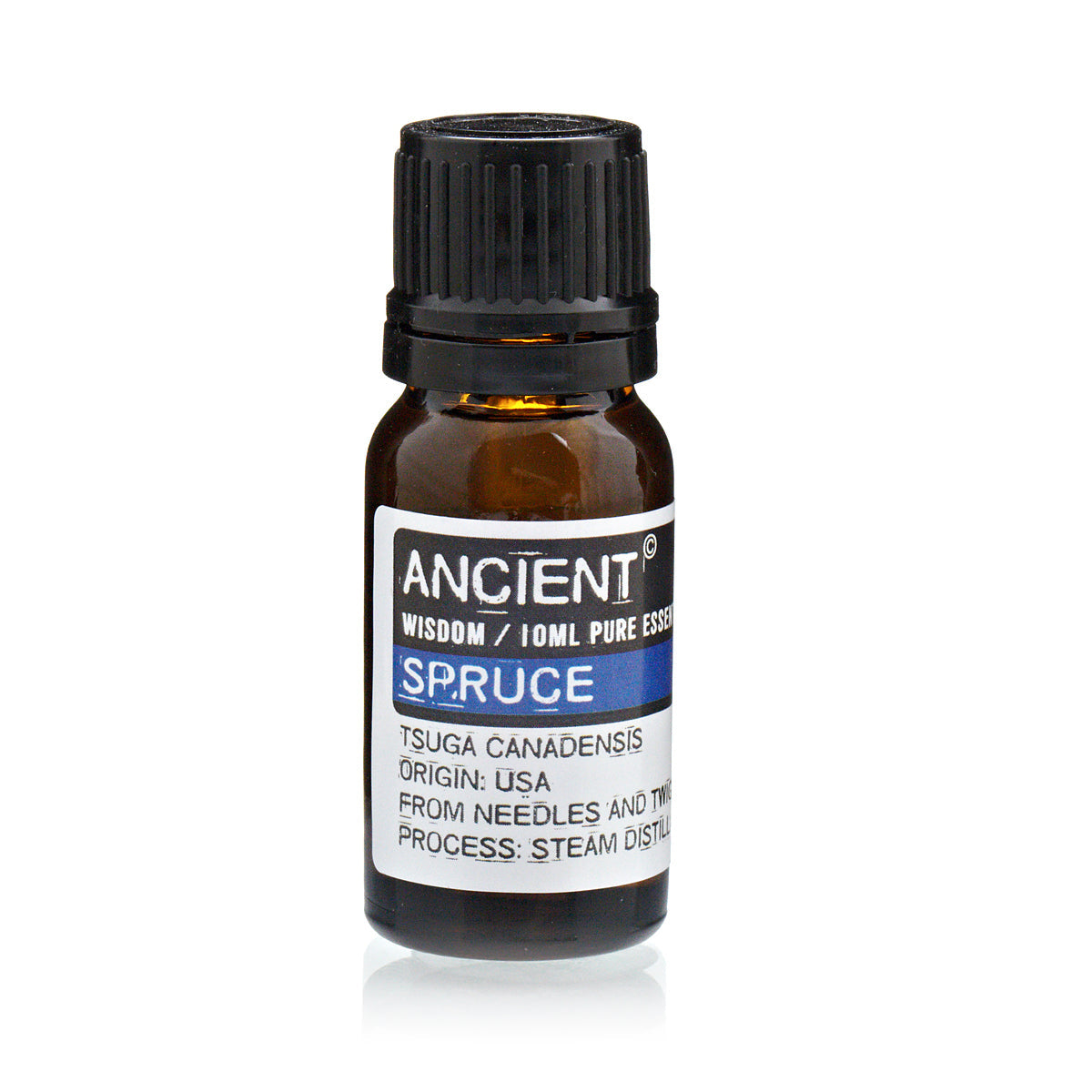
Spruce Essential Oil brings the feeling of a clean, cold forest into a room: crisp, conifer-green, lightly resinous, and quietly uplifting. This guide gives you a practical overview of the aroma, easy ways to use it, blending ideas, and safety notes so you can work with it calmly and confidently.
If you enjoy oils that feel fresh but not sharp, Spruce is a lovely middle ground. It has that woodland clarity people often want in winter, yet it also works well in everyday blends when you want a cleaner, more spacious atmosphere. It is a simple oil on the surface, but a very useful one once you start building with it.
Quick facts
- Botanical type: Spruce species essential oil
- Extraction: Steam distillation
- Aroma family: Fresh conifer, resinous, green, lightly woody
- Character: Bright, airy, forest-like
- Best for: Room freshness, winter blends, grounding-cool diffuser recipes
- Use level: Start low; it can take over a blend if overdone
Aroma profile
Spruce opens with a brisk, pine-forest freshness and then settles into a soft resinous heart. The effect is clean and spacious rather than heavy. Compared with denser woods, spruce feels more open and airy; compared with sweeter conifers, it is drier and more direct. That makes it especially useful when a blend needs structure without losing lift.
Think of it as a neat frame for other notes. Citrus becomes more grounded, herbs feel more organised, and deeper woods gain a brighter edge. In a room, spruce can suggest a fresh walk outside after rain: clear, cool, and quietly restorative without sounding dramatic.
How to use
Diffuser: begin with 2 drops in a small room or 3–4 drops in a larger diffuser. If you want a balanced everyday blend, let spruce play the support role rather than the lead.
Quiet reset: 2 spruce + 2 lemon + 1 cedarwood makes a tidy, bright room blend that feels fresh after cooking or cleaning. It is simple, direct, and easy to repeat.
Evening wind-down: 2 spruce + 2 lavender + 1 frankincense creates a calmer forest-like atmosphere with a soft, polished finish. This works especially well if you like cooler scents at the end of the day.
Room spray: if you prefer a mist, use a proper solubiliser and keep the concentration modest. Spruce is best when it is noticeable but not filling the whole room by itself.
Blends well with
- Citrus: Lemon, Grapefruit, Bergamot, Sweet Orange
- Woods: Cedarwood, Frankincense, Cypress
- Herbs: Rosemary, Lavender, Clary Sage
- Fresh notes: Eucalyptus, Peppermint (very lightly), Juniper Berry
Spruce is particularly good at making a recipe feel cleaner and more settled. If a citrus blend is too bright, spruce anchors it. If a wood blend feels too dark, spruce opens it. And if an herbal formula feels a bit loose, spruce adds tidy definition.
Why choose Spruce?
Spruce is a smart choice when you want the emotional effect of a forest scent without the sweetness some conifers carry. It feels calm, fresh, and organised. That makes it ideal for workspaces, hallway blends, and seasonal recipes where you want something crisp rather than cosy-sweet.
It also behaves nicely in small doses. A little spruce goes a long way, so it rewards restraint. Used carefully, it can make a blend feel taller, clearer, and more open — a useful trick whenever a formula starts to feel crowded or flat.
Safety & dilution
For external use only. Always dilute before applying to skin, and patch test first. If you are pregnant, nursing, under medical care, or planning to use essential oils with children or pets nearby, keep your use conservative and seek professional advice where needed. Never ingest the oil, and keep it away from eyes, lips, and other sensitive areas.
Because spruce is potent, treat it as a supporting note rather than a large-volume ingredient. For most home uses, a diffuser or a carefully diluted aromatic blend is the best fit. Store the bottle tightly closed, away from direct heat and sunlight.
Storage & shelf life
Keep Spruce Essential Oil in a cool, dark place with the cap firmly shut. That helps preserve the fresher top notes and slows down oxidation. If the aroma begins to smell dull or overly flat, it is usually a sign that the oil has been exposed to too much air or warmth over time.
Shop Spruce Essential Oil
Explore the product here: Shop Spruce Essential Oil →

Three easy blend ideas
- Forest clean: 2 spruce, 2 lemon, 1 cedarwood
- Winter air: 2 spruce, 2 bergamot, 1 frankincense
- Soft cabin: 2 spruce, 2 lavender, 1 cypress
These are deliberately simple so the spruce stays readable. If you want a blend to feel calmer, lower the total drop count before you increase complexity; spruce tends to keep its shape better that way.
When Spruce works best
Spruce is especially useful after busy days, during seasonal resets, or any time a room feels stale and you want the air to feel more open. It also performs well in shared spaces because it gives a sense of order without becoming sweet or heavy. For many people, that makes it easier to live with than stronger pine-like oils.
It is also a nice companion for simple routines. One short diffuser run can be enough to give a hallway, workspace, or kitchen a more settled feel. If the room already has a lot going on, spruce can act like the clear line that keeps the blend from wandering.
Storage & shelf life
Store Spruce Essential Oil in a cool, dark place, away from heat and direct sun. Cap it tightly after use. That helps preserve the fresher top notes and keeps the conifer character bright for longer. If the smell turns dull or flat, that usually means the bottle has spent too long open or warm.
- Solid Shampoo vs Liquid Shampoo: Which Is Better for Your Hair and the Environment?
 Switch to a more sustainable hair care routine with our premium solid shampoo bars , designed to cleanse, nourish, and protect your hair—without the waste of tr… Our solid shampoos are carefully crafted using… Read more: Solid Shampoo vs Liquid Shampoo: Which Is Better for Your Hair and the Environment?
 - Basil Essential Oil: The Clarifying Oil for Focus, Fatigue, and Muscle Relief
 Basil essential oil is one of the most underrated oils in aromatherapy. While it is universally recognised as a culinary herb, its essential oil has a distinct … Basil essential oil is steam-distilled from… Read more: Basil Essential Oil: The Clarifying Oil for Focus, Fatigue, and Muscle Relief
 - Lavender Essential Oil: The Complete Guide
 Lavender is where most people begin their aromatherapy journey — and for good reason. It is the most researched, most versatile, and most widely used essential … Lavender essential oil is steam-distilled from the… Read more: Lavender Essential Oil: The Complete Guide
 - Fennel Essential Oil: The Digestive Oil for Bloating, Hormones, and Detox
 Fennel has been used medicinally for thousands of years — by the ancient Egyptians, Greeks, Romans, and Chinese — primarily for its remarkable digestive propert… Fennel essential oil is steam-distilled from the crushed seeds… Read more: Fennel Essential Oil: The Digestive Oil for Bloating, Hormones, and Detox
 - Patchouli Essential Oil: The Earthy Oil for Grounding, Skin, and Sensuality
 Few essential oils provoke as strong a reaction as patchouli. Its deep, earthy, slightly sweet scent is immediately recognisable — and deeply divisive. Those wh… Patchouli essential oil is steam-distilled from the dried, fermented… Read more: Patchouli Essential Oil: The Earthy Oil for Grounding, Skin, and Sensuality
 - Peppermint Essential Oil: Energise, Focus, and Refresh
 If lavender is the oil of calm, peppermint is the oil of clarity. Sharp, cool, and instantly recognisable, peppermint essential oil is one of the most effective… Peppermint essential oil is steam-distilled from the… Read more: Peppermint Essential Oil: Energise, Focus, and Refresh