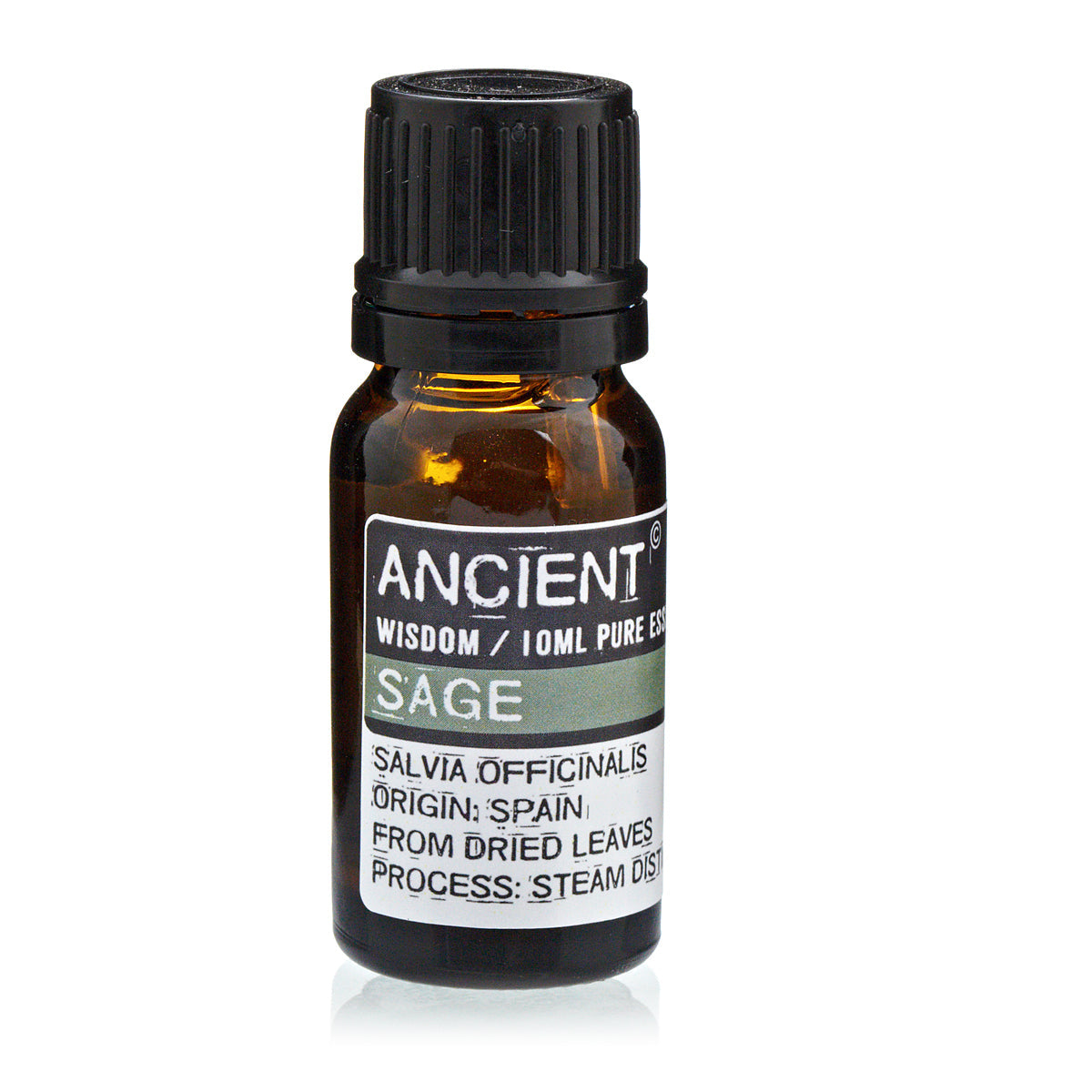
Sage Essential Oil has a distinctly dry, herbal personality: green, slightly camphoraceous, clean and very structured. It feels like a tidy herb garden after rain — bright leaves, a little aromatic lift, and a grounded backbone that keeps the scent from wandering off into sweetness. If you like oils that feel clear-headed rather than cosy, Sage is an excellent fit.
This is one of those oils that quietly changes a blend rather than dominating it. A small amount can sharpen a diffuser mix, bring definition to softer notes and make a room feel fresher without pushing into mint territory. The result is practical, versatile and nicely grown-up.
Quick facts
- Botanical name: Salvia officinalis
- Plant part: Dried leaves
- Origin: Spain
- Extraction: Steam distillation
- Aroma: Dry, herbal, green and lightly camphoraceous
- Character: Clear, structured, slightly medicinal but pleasantly natural
Aroma profile
Sage opens with a crisp herbaceous note, then settles into a drier, more aromatic green body. It has a tidy, almost architectural quality: not soft and floral, not sweet and round, but neat and purposeful. That makes it especially useful when a blend needs a little spine.
In a room, Sage can make the atmosphere feel fresher and more orderly. In a blend, it helps the other notes behave. Think of it as a precision herb — a small amount goes a long way.
How to use
Use in well-ventilated spaces and keep quantities modest. Sage is strong enough that restraint usually gives the best result.
Diffuser ideas
- Herbal reset: 2 drops Sage + 2 drops Lemon + 1 drop Cedarwood
- Desk clarity: 2 drops Sage + 2 drops Rosemary + 2 drops Grapefruit
- Fresh earth: 2 drops Sage + 2 drops Cypress + 1 drop Lavender
If you want a room to feel cleaner and more composed, Sage works well with citrus. If you want it to feel more grounded, pair it with woods. If you want to smooth the sharper edges, add a soft floral note in a smaller amount.
Blends well with
- Citrus: Lemon, Grapefruit, Bergamot, Orange
- Herbs: Rosemary, Basil, Lavender
- Woods: Cedarwood, Cypress, Pine
Good blend logic: Sage often works best as a support note. Use citrus for lift, woods for depth, and a soft floral to take the edge off if needed. That keeps the blend herbal without becoming harsh.
Everyday uses
Sage is ideal when you want the atmosphere to feel neat, fresh and a bit more serious. It suits morning diffuser blends, study spaces, after-cleaning routines and other moments where clarity matters more than softness. It also combines nicely with other green notes if you want a more botanical character.
A simple starting blend is Sage with Lemon and Cedarwood: clean, crisp and tidy. For something brighter, add Grapefruit. For something more grounded, bring in Cypress. For a gentler edge, keep Sage low and let Lavender do the smoothing.
Safety & dilution
- For external, aromatic use only.
- Always dilute before skin use and patch test first.
- Avoid eyes, lips and sensitive areas.
- Keep out of reach of children and pets.
- If pregnant, breastfeeding or under medical care, seek qualified advice before use.
Sage is a concentrated essential oil and should be treated with care. Less is usually better. Store it tightly closed, away from heat and light, so the aroma stays fresh and stable.
Shop Sage Essential Oil

- Solid Shampoo vs Liquid Shampoo: Which Is Better for Your Hair and the Environment?
 Switch to a more sustainable hair care routine with our premium solid shampoo bars , designed to cleanse, nourish, and protect your hair—without the waste of tr… Our solid shampoos are carefully crafted using… Read more: Solid Shampoo vs Liquid Shampoo: Which Is Better for Your Hair and the Environment?
 - Basil Essential Oil: The Clarifying Oil for Focus, Fatigue, and Muscle Relief
 Basil essential oil is one of the most underrated oils in aromatherapy. While it is universally recognised as a culinary herb, its essential oil has a distinct … Basil essential oil is steam-distilled from… Read more: Basil Essential Oil: The Clarifying Oil for Focus, Fatigue, and Muscle Relief
 - Lavender Essential Oil: The Complete Guide
 Lavender is where most people begin their aromatherapy journey — and for good reason. It is the most researched, most versatile, and most widely used essential … Lavender essential oil is steam-distilled from the… Read more: Lavender Essential Oil: The Complete Guide
 - Fennel Essential Oil: The Digestive Oil for Bloating, Hormones, and Detox
 Fennel has been used medicinally for thousands of years — by the ancient Egyptians, Greeks, Romans, and Chinese — primarily for its remarkable digestive propert… Fennel essential oil is steam-distilled from the crushed seeds… Read more: Fennel Essential Oil: The Digestive Oil for Bloating, Hormones, and Detox
 - Patchouli Essential Oil: The Earthy Oil for Grounding, Skin, and Sensuality
 Few essential oils provoke as strong a reaction as patchouli. Its deep, earthy, slightly sweet scent is immediately recognisable — and deeply divisive. Those wh… Patchouli essential oil is steam-distilled from the dried, fermented… Read more: Patchouli Essential Oil: The Earthy Oil for Grounding, Skin, and Sensuality
 - Peppermint Essential Oil: Energise, Focus, and Refresh
 If lavender is the oil of calm, peppermint is the oil of clarity. Sharp, cool, and instantly recognisable, peppermint essential oil is one of the most effective… Peppermint essential oil is steam-distilled from the… Read more: Peppermint Essential Oil: Energise, Focus, and Refresh