
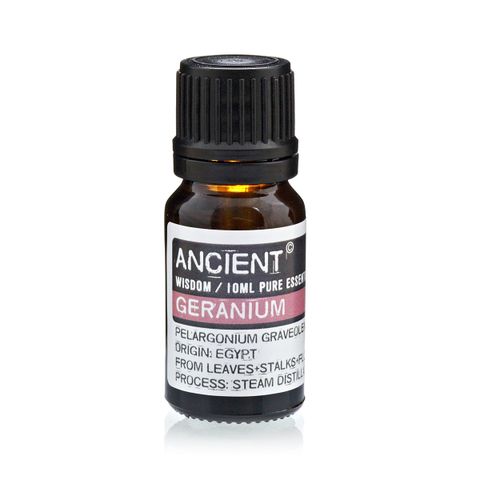
Latin Name : Pelargonium Graveolens.
Part Of Plant Used : Leaves, Stalks & Flowers.
Source : Egypt.
Extraction Method : Steam Distillation.
Geranium Essential Oil is obtained through steam distillation of the leaves and stems of Pelargonium odoratissimum, commonly known as apple geranium. The oil features a rich floral aroma with delicate minty and apple-like nuances. It is widely valued for its balancing and uplifting qualities, supporting both emotional wellbeing and physical health by helping to ease a range of discomforts.
Renowned for its ability to balance both oily and dry skin, geranium essential oil also has calming properties that help reduce stress and anxiety. It is traditionally believed to support the adrenal cortex, assisting in the regulation of the hormonal system. This versatile oil has long been used to help manage various conditions, including acne, bruises, burns, cuts, dermatitis, eczema, haemorrhoids, ringworm, ulcers, breast engorgement, oedema, poor circulation, sore throats, tonsillitis, PMS, menopausal discomfort, stress, and neuralgia. Its strong natural fragrance acts as an effective mosquito repellent, and when added to shampoo, it may help deter head lice.
Historically, geranium plants were thought to offer protection from negative energies, much like their natural ability to repel insects, which led to their use as hedges around homes. Native to regions including South Africa, Réunion, Madagascar, Egypt, and Morocco, geraniums were introduced to Europe in the 17th century. Although there are approximately 700 varieties of geranium, only around 10 produce sufficient essential oil to make commercial extraction viable, as most garden varieties yield too little oil for this purpose.
You can Click, Tap or Scan the QR code below. It will automatically add a discount code for you to get a discount on your first purchase, of any of our essential oil 10ml bottles. Terms and Conditions apply.


- Solid Shampoo vs Liquid Shampoo: Which Is Better for Your Hair and the Environment?
 Switch to a more sustainable hair care routine with our premium solid shampoo bars , designed to cleanse, nourish, and protect your hair—without the waste of tr… Our solid shampoos are carefully crafted using… Read more: Solid Shampoo vs Liquid Shampoo: Which Is Better for Your Hair and the Environment?
 - Basil Essential Oil: The Clarifying Oil for Focus, Fatigue, and Muscle Relief
 Basil essential oil is one of the most underrated oils in aromatherapy. While it is universally recognised as a culinary herb, its essential oil has a distinct … Basil essential oil is steam-distilled from… Read more: Basil Essential Oil: The Clarifying Oil for Focus, Fatigue, and Muscle Relief
 - Lavender Essential Oil: The Complete Guide
 Lavender is where most people begin their aromatherapy journey — and for good reason. It is the most researched, most versatile, and most widely used essential … Lavender essential oil is steam-distilled from the… Read more: Lavender Essential Oil: The Complete Guide
 - Fennel Essential Oil: The Digestive Oil for Bloating, Hormones, and Detox
 Fennel has been used medicinally for thousands of years — by the ancient Egyptians, Greeks, Romans, and Chinese — primarily for its remarkable digestive propert… Fennel essential oil is steam-distilled from the crushed seeds… Read more: Fennel Essential Oil: The Digestive Oil for Bloating, Hormones, and Detox
 - Patchouli Essential Oil: The Earthy Oil for Grounding, Skin, and Sensuality
 Few essential oils provoke as strong a reaction as patchouli. Its deep, earthy, slightly sweet scent is immediately recognisable — and deeply divisive. Those wh… Patchouli essential oil is steam-distilled from the dried, fermented… Read more: Patchouli Essential Oil: The Earthy Oil for Grounding, Skin, and Sensuality
 - Peppermint Essential Oil: Energise, Focus, and Refresh
 If lavender is the oil of calm, peppermint is the oil of clarity. Sharp, cool, and instantly recognisable, peppermint essential oil is one of the most effective… Peppermint essential oil is steam-distilled from the… Read more: Peppermint Essential Oil: Energise, Focus, and Refresh