
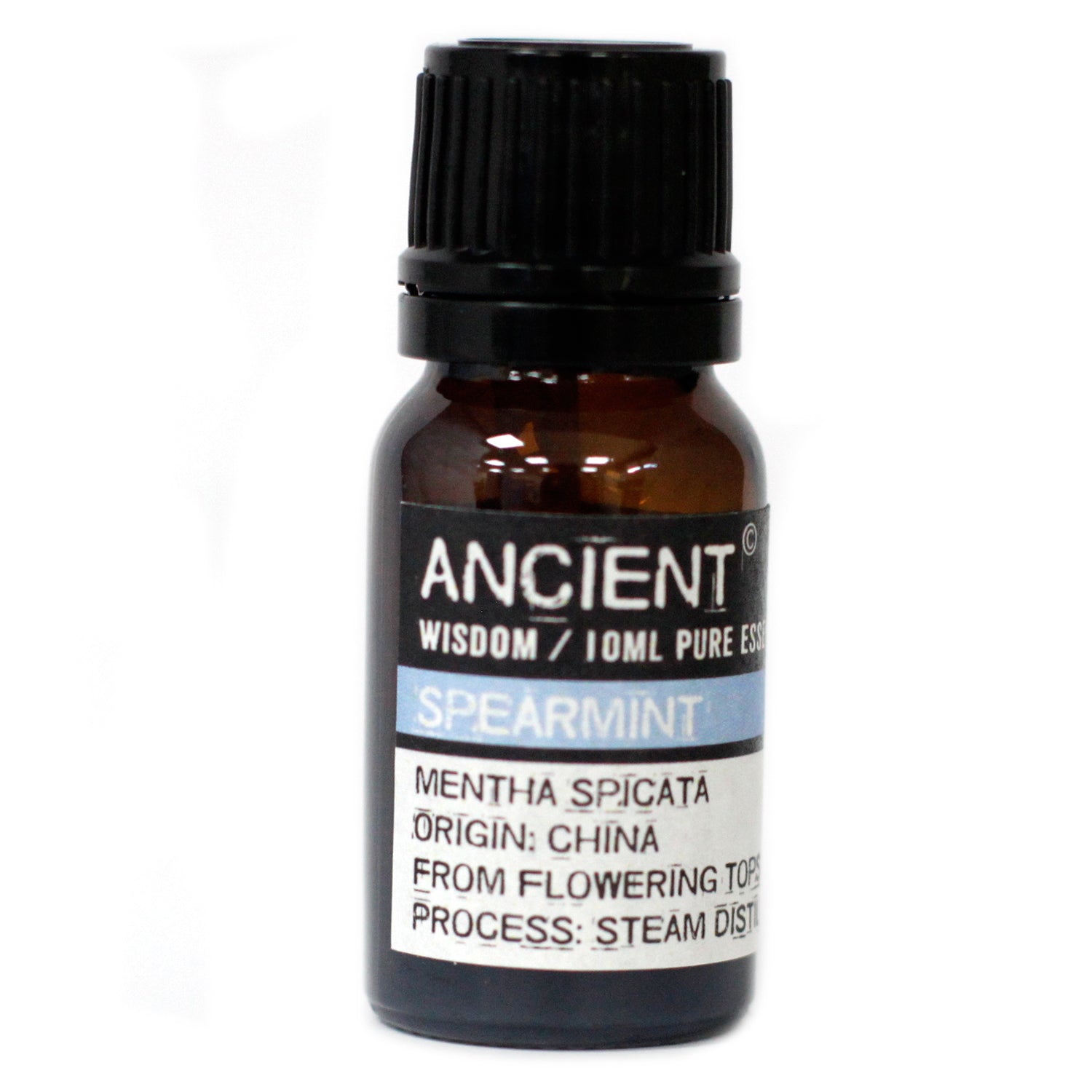
Spearmint Essential Oil – Clean, gently sweet and instantly uplifting, Spearmint (Mentha spicata) Essential Oil brings a softer, more serene mint profile than its bracing cousin Peppermint. Its silky, herbaceous freshness cuts through stuffy rooms, helps reset a tired mind, and layers beautifully with citrus and florals for bright, mood-lifting blends you can enjoy throughout the day. Distilled from the flowering tops of the spearmint plant, this oil is naturally rich in carvone, the signature molecule that gives spearmint its mellow, candy‑mint character without the intense iciness of menthol.
Quick facts
- Botanical name: Mentha spicata
- Plant family: Lamiaceae
- Plant part: Leaves and flowering tops
- Extraction: Steam distillation
- Aroma: Sweet, minty, fresh and lightly herbal with a soft, gentle coolness
- Main constituents: Carvone (typically the dominant component), with limonene and others present in smaller amounts
- Strength: Light–medium; less intense than Peppermint
- Note: Top to top–middle
Aroma profile
Spearmint opens with a bright, buoyant sweetness — think garden‑fresh mint leaves crushed between your fingers — supported by soft herbal facets and a whisper of citrus sparkle. Where Peppermint can feel bracing and ultra‑cool, Spearmint stays friendly and rounded. That makes it a superb everyday mint for households, shared workspaces, and calm‑energy blends where you want clarity without the “too cold” bite.
How to use
Diffuser ideas
- Morning clarity: 3 drops Spearmint + 3 drops Sweet Orange + 1 drop Rosemary
- After‑work reset: 3 drops Spearmint + 2 drops Lavender + 2 drops Bergamot
- Kitchen fresh: 3 drops Spearmint + 2 drops Lemon + 1 drop Eucalyptus
Simple topical applications
Always dilute essential oils in a carrier oil before applying to skin. Typical aromatherapy dilutions are around 1% for daily, leave‑on use on smaller areas (about 1 drop of essential oil per 5 ml carrier), and up to 2–3% for short‑term, adult use on larger areas. Perform a patch test first and avoid eyes, lips and mucous membranes.
- Bright focus roller: In a 10 ml roller, add 2 drops Spearmint, 2 drops Grapefruit and 1 drop Petitgrain; top with fractionated coconut oil. Swipe to pulse points during the afternoon slump.
- Post‑exercise rub: 3% blend in a light carrier (e.g., grapeseed) with Spearmint, Cypress and Lavender for a cooling, fresh body oil. Use on intact skin only.
- Shower boost: Add 1–2 drops to a tablespoon of unscented shower gel; lather and rinse. (Not for bath use without proper dispersant.)
Blends well with
Spearmint is a natural team‑player. It brightens and softens sharper notes, and adds lift to heavier florals and woods. Try it with:
- Citrus: Sweet Orange, Grapefruit, Mandarin, Lime
- Herbs & woods: Rosemary, Basil, Cypress, Cedarwood
- Floral & exotic: Geranium, Jasmine (dilute), Ylang Ylang
Blending tips
Start low — Spearmint’s cheerful top‑note travels far in the air. In diffusers, 1 part Spearmint to 2–3 parts citrus keeps things bright without turning toothpaste‑minty; on skin, reserve Spearmint for accent (often 10–20% of your essential‑oil blend within the overall carrier dilution). Pair with soft florals like Geranium to round any sharp edges, or add a thread of Cedarwood to anchor the sweetness for evening use.
Why choose Spearmint?
If you love mint but find Peppermint too intense for everyday settings, Spearmint offers the refreshing clarity you want in a gentler, friendlier form. Its smooth sweetness works beautifully for family spaces, creative sessions, and calm‑energy mornings. It’s also a superb “bridge” note for uniting citrus and floral blends, lifting heavy bases and helping clean accords feel more natural and nuanced.
Spearmint vs Peppermint — what’s the difference?
Both oils are unmistakably “minty,” yet they behave quite differently in blends. Peppermint (rich in menthol and menthone) feels intensely cool and razor‑sharp; a single drop can dominate. Spearmint, led by carvone, is smoother and more rounded. In practice, Spearmint gives you uplift without overload — ideal when you want a friendly mint that plays nicely with citrus, florals and woods, or when you’re scenting shared spaces.
Quality & sourcing
We prefer clean, well‑distilled Spearmint with a bright, true‑leaf character and a comfortably sweet dry‑down. Batch composition naturally varies by origin and season; high‑quality lots consistently show carvone as the major constituent with a supporting cast of terpenes (such as limonene). Each batch is assessed for aroma, clarity and freshness.
Everyday tips
- Study buddy: Diffuse a Spearmint–Lime–Petitgrain trio during focused tasks; reserve a matching roller (at 1–2%) for on‑the‑go continuity.
- Fresh car blend: 2 drops Spearmint + 2 drops Grapefruit on an absorbent card kept safely away from direct skin contact.
- Gym bag sachet: 1 drop Spearmint on a reusable cotton pad inside a zipped pocket to keep things smelling crisp.
Storage & shelf life
To help keep your Spearmint oil fresh, store it in a cool, dark place with the cap tightly closed. Minimise air exposure and return the dropper quickly after use. Properly stored, unopened bottles typically remain at their best for up to 2–3 years.
Safety & dilution
- For external, aromatic use only. Do not ingest.
- Keep out of reach of children and pets; avoid use with infants. If pregnant, breastfeeding, taking medication or under medical care, seek advice from a qualified professional.
- Always dilute appropriately before skin use; patch test first. Discontinue use if irritation occurs.
- Store away from heat and sunlight; keep the cap tightly closed.
Spearmint essential oil is typically high in the natural compound carvone, which shapes its sweet‑mint aroma. Composition varies with plant variety and growing region, but carvone is generally the dominant constituent. As with any essential oil rich in specific components, sensible dilution and short‑term, intermittent use help maintain skin comfort and enjoyment.
Shop Spearmint Essential Oil
Ready to experience this bright, silky‑sweet mint? Visit our product page below:
Shop Spearmint Essential Oil →

References for further reading: General aroma profile and blending suggestions for Spearmint (Mentha spicata) are widely documented in reputable aromatherapy references and safety‑minded organisations. See, for example, AromaWeb’s Spearmint profile and peer‑reviewed reviews of Mentha essential oil chemistry noting the predominance of carvone in spearmint chemotypes.
- Solid Shampoo vs Liquid Shampoo: Which Is Better for Your Hair and the Environment?
 Switch to a more sustainable hair care routine with our premium solid shampoo bars , designed to cleanse, nourish, and protect your hair—without the waste of tr… Our solid shampoos are carefully crafted using… Read more: Solid Shampoo vs Liquid Shampoo: Which Is Better for Your Hair and the Environment?
 - Basil Essential Oil: The Clarifying Oil for Focus, Fatigue, and Muscle Relief
 Basil essential oil is one of the most underrated oils in aromatherapy. While it is universally recognised as a culinary herb, its essential oil has a distinct … Basil essential oil is steam-distilled from… Read more: Basil Essential Oil: The Clarifying Oil for Focus, Fatigue, and Muscle Relief
 - Lavender Essential Oil: The Complete Guide
 Lavender is where most people begin their aromatherapy journey — and for good reason. It is the most researched, most versatile, and most widely used essential … Lavender essential oil is steam-distilled from the… Read more: Lavender Essential Oil: The Complete Guide
 - Fennel Essential Oil: The Digestive Oil for Bloating, Hormones, and Detox
 Fennel has been used medicinally for thousands of years — by the ancient Egyptians, Greeks, Romans, and Chinese — primarily for its remarkable digestive propert… Fennel essential oil is steam-distilled from the crushed seeds… Read more: Fennel Essential Oil: The Digestive Oil for Bloating, Hormones, and Detox
 - Patchouli Essential Oil: The Earthy Oil for Grounding, Skin, and Sensuality
 Few essential oils provoke as strong a reaction as patchouli. Its deep, earthy, slightly sweet scent is immediately recognisable — and deeply divisive. Those wh… Patchouli essential oil is steam-distilled from the dried, fermented… Read more: Patchouli Essential Oil: The Earthy Oil for Grounding, Skin, and Sensuality
 - Peppermint Essential Oil: Energise, Focus, and Refresh
 If lavender is the oil of calm, peppermint is the oil of clarity. Sharp, cool, and instantly recognisable, peppermint essential oil is one of the most effective… Peppermint essential oil is steam-distilled from the… Read more: Peppermint Essential Oil: Energise, Focus, and Refresh
Love this stuff