
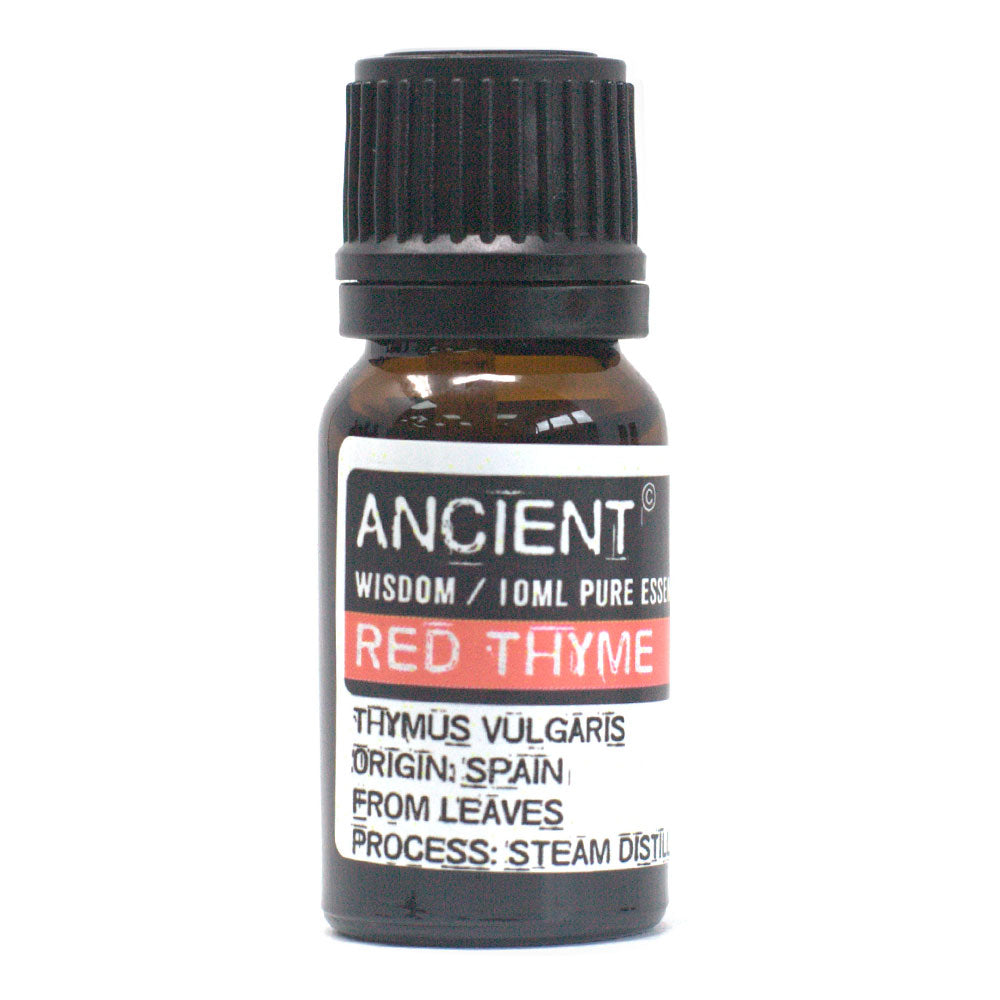
Red Thyme Essential Oil is bright, herbal and powerfully aromatic, with a dry green bite that feels focused and assertive. It is one of those oils that immediately says “clean, sharp, no nonsense.” If you want a scent that feels strong and purposeful, Red Thyme gets there quickly.
This is not a gentle oil, and that is exactly why it is useful. A small amount can bring structure to a blend, sharpen the green notes and keep a composition from feeling soft or vague.
Quick facts
- Botanical name: Thymus vulgaris
- Plant part: Aerial parts
- Origin: Spain
- Extraction: Steam distillation
- Aroma: Sharp, herbal, dry and green
- Character: Strong, direct and clear
Aroma profile
Red Thyme opens with a vigorous herbal snap and settles into a dry green body that feels crisp and very defined. It is more assertive than softer herbs, so it works best when a blend needs backbone and discipline.
In practice, that means Red Thyme can give a diffuser blend sharper edges, help cleaner aromas read more clearly and keep the atmosphere feeling tidy. It is a classic “small amount, big effect” oil.
How to use
Use in very small amounts in well-ventilated spaces. Red Thyme is potent and usually only needs a drop or two.
Diffuser ideas
- Herbal clean: 1 drop Red Thyme + 2 drops Lemon + 1 drop Cedarwood
- Green focus: 1 drop Red Thyme + 2 drops Rosemary + 1 drop Grapefruit
- Sharp reset: 1 drop Red Thyme + 2 drops Cypress + 1 drop Lavender
Red Thyme works best as a support note. Citrus can soften the intensity, woods can ground it and lavender can take the edge off if needed. Keep the ratio low and it becomes far more versatile.
Blends well with
- Citrus: Lemon, Grapefruit, Orange, Lime
- Herbs: Rosemary, Sage, Lavender
- Woods: Cedarwood, Cypress, Pine
Good blend logic: use Red Thyme for a very small amount of sharp herbal clarity, then build around it with citrus or woods. It is excellent when you want the blend to feel crisp and intentional.
Everyday uses
Red Thyme suits practical freshening routines, morning blends and any space that needs a more disciplined herbal atmosphere. It is a strong oil, so think “accent,” not “base.”
A simple starting blend is Red Thyme with Lemon and Cedarwood. For a greener result, add Rosemary. For a softer impression, keep Red Thyme to a single drop and round it out with Lavender.
Safety & dilution
- For external, aromatic use only.
- Always dilute before skin use and patch test first.
- Use very sparingly; this oil is potent and can irritate if overused.
- Avoid eyes, lips and sensitive areas.
- Keep out of reach of children and pets.
- If pregnant, breastfeeding or under medical care, seek qualified advice before use.
Red Thyme is a concentrated essential oil and should be used carefully. Store it tightly closed, away from heat and light, and keep the dosage low so the aroma stays crisp rather than harsh.
Shop Red Thyme Essential Oil
Shop Red Thyme Essential Oil →

- Solid Shampoo vs Liquid Shampoo: Which Is Better for Your Hair and the Environment?
 Switch to a more sustainable hair care routine with our premium solid shampoo bars , designed to cleanse, nourish, and protect your hair—without the waste of tr… Our solid shampoos are carefully crafted using… Read more: Solid Shampoo vs Liquid Shampoo: Which Is Better for Your Hair and the Environment?
 - Basil Essential Oil: The Clarifying Oil for Focus, Fatigue, and Muscle Relief
 Basil essential oil is one of the most underrated oils in aromatherapy. While it is universally recognised as a culinary herb, its essential oil has a distinct … Basil essential oil is steam-distilled from… Read more: Basil Essential Oil: The Clarifying Oil for Focus, Fatigue, and Muscle Relief
 - Lavender Essential Oil: The Complete Guide
 Lavender is where most people begin their aromatherapy journey — and for good reason. It is the most researched, most versatile, and most widely used essential … Lavender essential oil is steam-distilled from the… Read more: Lavender Essential Oil: The Complete Guide
 - Fennel Essential Oil: The Digestive Oil for Bloating, Hormones, and Detox
 Fennel has been used medicinally for thousands of years — by the ancient Egyptians, Greeks, Romans, and Chinese — primarily for its remarkable digestive propert… Fennel essential oil is steam-distilled from the crushed seeds… Read more: Fennel Essential Oil: The Digestive Oil for Bloating, Hormones, and Detox
 - Patchouli Essential Oil: The Earthy Oil for Grounding, Skin, and Sensuality
 Few essential oils provoke as strong a reaction as patchouli. Its deep, earthy, slightly sweet scent is immediately recognisable — and deeply divisive. Those wh… Patchouli essential oil is steam-distilled from the dried, fermented… Read more: Patchouli Essential Oil: The Earthy Oil for Grounding, Skin, and Sensuality
 - Peppermint Essential Oil: Energise, Focus, and Refresh
 If lavender is the oil of calm, peppermint is the oil of clarity. Sharp, cool, and instantly recognisable, peppermint essential oil is one of the most effective… Peppermint essential oil is steam-distilled from the… Read more: Peppermint Essential Oil: Energise, Focus, and Refresh
Really helpful guide, thank you — looking forward to more like this!