
Intro
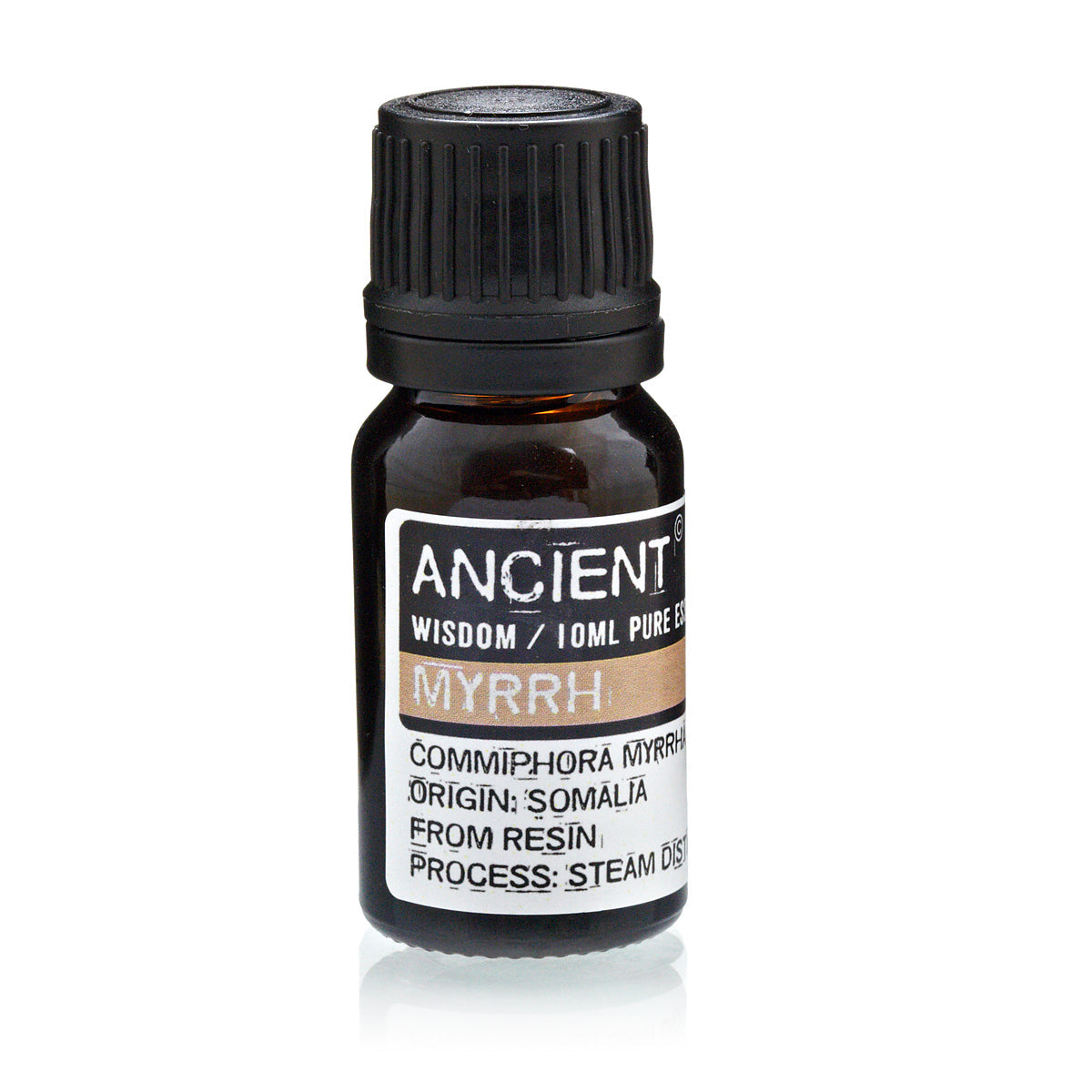
Resinous, amber-warm, and quietly profound, myrrh has perfumed sacred spaces and everyday rituals for millennia. Steam‑distilled from the oleo‑gum‑resin of Commiphora myrrha, its grounding base note lends depth to blends and a sense of calm to mindful routines. Today, it’s prized as much for its meditative character as for the way it anchors and rounds brighter or floral notes.
Quick facts
- Botanical name: Commiphora myrrha
- Family: Burseraceae
- Plant part: Resin (oleo‑gum‑resin), steam‑distilled
- Note: Base; intensity: medium–strong
- Aroma: warm, woody, earthy, balsamic
- Major constituents (typical): furanoeudesma‑1,3‑diene, furanodiene, lindestrene, β‑elemene, germacrene B/D
- Pairs with: frankincense, cedarwood, sandalwood, cypress, patchouli, vetiver; citrus (orange, bergamot); spice (cardamom, ginger)
Aroma profile
Myrrh opens with softly smoky, ambery‑balsamic tones before settling into dry woods and resin. In blends it behaves like a low, steady drumbeat—subtle on its own, but transformative when it supports brighter or floral notes. Pairing it with frankincense amplifies the incense facet; adding cedarwood or sandalwood pulls it toward polished woods; folding in orange or bergamot lifts and freshens the base without losing depth.
How to use
- Diffusion (calm focus): 3–6 drops in 100 mL water. Try 3 myrrh + 2 orange + 1 cedarwood for a warm, welcoming blend.
- Evening unwind: 2 myrrh + 2 frankincense + 1 bergamot in 100 mL; run 30–60 minutes.
- Topical (daily body use): 1–2% dilution in a carrier (e.g., 6–12 drops per 30 mL/1 oz). For small, occasional target spots, up to ~3% is a common upper range for adults with intact skin; always patch test and adjust down for sensitive skin.
- Perfumery anchor: 0.5–1% of total perfume concentrate gives tenacity and a resinous trail.
- Bath (aroma soak): Disperse first—mix up to 4–6 drops total essential oil into 1 Tbsp carrier plus 1 tsp solubilizer; add to a filled tub and swirl. Never drop neat oils into bathwater.
Blends well with
- Woods/resins: frankincense, cedarwood (atlas/virginian), sandalwood, cypress, juniper berry, patchouli, vetiver
- Florals: rose, jasmine (sparingly), ylang ylang
- Citrus: sweet orange, bergamot (FCF), mandarin
- Spices: cardamom, ginger, clove (very low amounts)
Safety & dilution
- Pregnancy/lactation: Avoid—myrrh oil is noted as potentially fetotoxic/contraindicated; do not use during pregnancy or while breastfeeding.
- General: Do not ingest essential oils. Keep away from eyes/mucous membranes. Store tightly capped, away from heat/light; discard oxidized oil. Use extra caution with children and those with medical conditions; when in doubt, consult a qualified practitioner.
- Patch test: Dilute first; apply a small amount to inner forearm; monitor 24 hours.
Shop
Explore Vivid Aromas Myrrh Essential Oil (10 mL) and add a warm, resinous anchor to your blends:

https://shop.vividaromas.uk/discount/MainSite4?redirect=/products/10-ml-myrrh-essential-oil
Origins & extraction
Myrrh comes from hardy trees native to arid regions of Northeast Africa and the Arabian Peninsula. When the bark is gently scored, the tree exudes a sticky oleo‑gum‑resin that hardens into golden tears. These are cleaned and carefully steam‑distilled to produce essential oil. Yield is modest, and small changes in climate, soil and harvesting practice influence the aromatic profile. This is why you may notice subtle differences between lots—a normal feature of a natural product rather than a defect.
Quality & sourcing notes
High‑quality myrrh essential oil should smell clean, dry‑woody and balsamic, with a softly smoky depth and very little harshness. Look for suppliers who provide GC/MS analysis and clear batch numbers, and store your bottle tightly capped to limit oxidation. Because of its resinous chemistry, myrrh can thicken over time; warming the sealed bottle briefly in your hands can make drops dispense more easily. If your oil has become very thick or smells sharp and stale, it may be time to replace it.
Blend ideas to try
- Incense glow: 2 drops myrrh + 2 drops frankincense + 1 drop cedarwood atlas. Calm, meditative and gently wood‑smoked.
- Amber citrus: 2 drops myrrh + 3 drops sweet orange + 1 drop bergamot (FCF). Cozy, bright and welcoming.
- Polished woods: 1 drop myrrh + 2 drops sandalwood + 1 drop vetiver. Smooth, elegant base for evening relaxation.
Storage & shelf life
Store myrrh essential oil in a cool, dark place with the lid tightly closed. As with most resin‑rich oils, it is relatively stable when protected from air and light. For best aroma, aim to use within 2–3 years of opening; always check scent and color before use, and reduce topical percentages for older oils.
FAQs
Is myrrh essential oil the same as myrrh resin? The oil is steam‑distilled from the resin. The aroma family overlaps, but the oil is more mobile and easier to blend into carriers and perfumes.
Can I apply myrrh neat? We recommend always diluting in a carrier. Start at 1–2% for general body applications and patch test on a small area first.
Is it safe for children? Use a conservative approach, diffuse for short periods in a well‑ventilated room, and avoid direct topical use on young children. When in doubt, consult a qualified practitioner.
Pro tips
Scent layering: To add radiance, blend a tiny amount of floral (rose or jasmine) into a myrrh + cedarwood base; the floral lifts the resin without overpowering it. For daytime freshness, pair myrrh with petitgrain and a slice of grapefruit.
Diffuser safety: Keep rooms ventilated, diffuse for 20–40 minutes, and take breaks. Pets and sensitive individuals may prefer very low amounts or passive diffusion (drops on a blotter placed nearby).
- Solid Shampoo vs Liquid Shampoo: Which Is Better for Your Hair and the Environment?
 Switch to a more sustainable hair care routine with our premium solid shampoo bars , designed to cleanse, nourish, and protect your hair—without the waste of tr… Our solid shampoos are carefully crafted using… Read more: Solid Shampoo vs Liquid Shampoo: Which Is Better for Your Hair and the Environment?
 - Basil Essential Oil: The Clarifying Oil for Focus, Fatigue, and Muscle Relief
 Basil essential oil is one of the most underrated oils in aromatherapy. While it is universally recognised as a culinary herb, its essential oil has a distinct … Basil essential oil is steam-distilled from… Read more: Basil Essential Oil: The Clarifying Oil for Focus, Fatigue, and Muscle Relief
 - Lavender Essential Oil: The Complete Guide
 Lavender is where most people begin their aromatherapy journey — and for good reason. It is the most researched, most versatile, and most widely used essential … Lavender essential oil is steam-distilled from the… Read more: Lavender Essential Oil: The Complete Guide
 - Fennel Essential Oil: The Digestive Oil for Bloating, Hormones, and Detox
 Fennel has been used medicinally for thousands of years — by the ancient Egyptians, Greeks, Romans, and Chinese — primarily for its remarkable digestive propert… Fennel essential oil is steam-distilled from the crushed seeds… Read more: Fennel Essential Oil: The Digestive Oil for Bloating, Hormones, and Detox
 - Patchouli Essential Oil: The Earthy Oil for Grounding, Skin, and Sensuality
 Few essential oils provoke as strong a reaction as patchouli. Its deep, earthy, slightly sweet scent is immediately recognisable — and deeply divisive. Those wh… Patchouli essential oil is steam-distilled from the dried, fermented… Read more: Patchouli Essential Oil: The Earthy Oil for Grounding, Skin, and Sensuality
 - Peppermint Essential Oil: Energise, Focus, and Refresh
 If lavender is the oil of calm, peppermint is the oil of clarity. Sharp, cool, and instantly recognisable, peppermint essential oil is one of the most effective… Peppermint essential oil is steam-distilled from the… Read more: Peppermint Essential Oil: Energise, Focus, and Refresh
Really helpful guide, thank you — looking forward to more like this!